
Sea freight packaging
Sea-proof packaging solutions for worldwide transport under demanding conditions.
Sea freight packaging in Regensburg
Sea freight packaging protects components and machines during long transport routes, changing climate zones and repeated transhipments. In industrial and manufacturing companies in Regensburg, sea freight packaging includes the preservation, foiling, fixing and securing of goods in aluminum composite film with a calculated amount of desiccant to prevent corrosion and moisture entry.
The packaging not only takes weight and shape into account, but above all temperature changes, condensation, humidity and vibrations during transport.
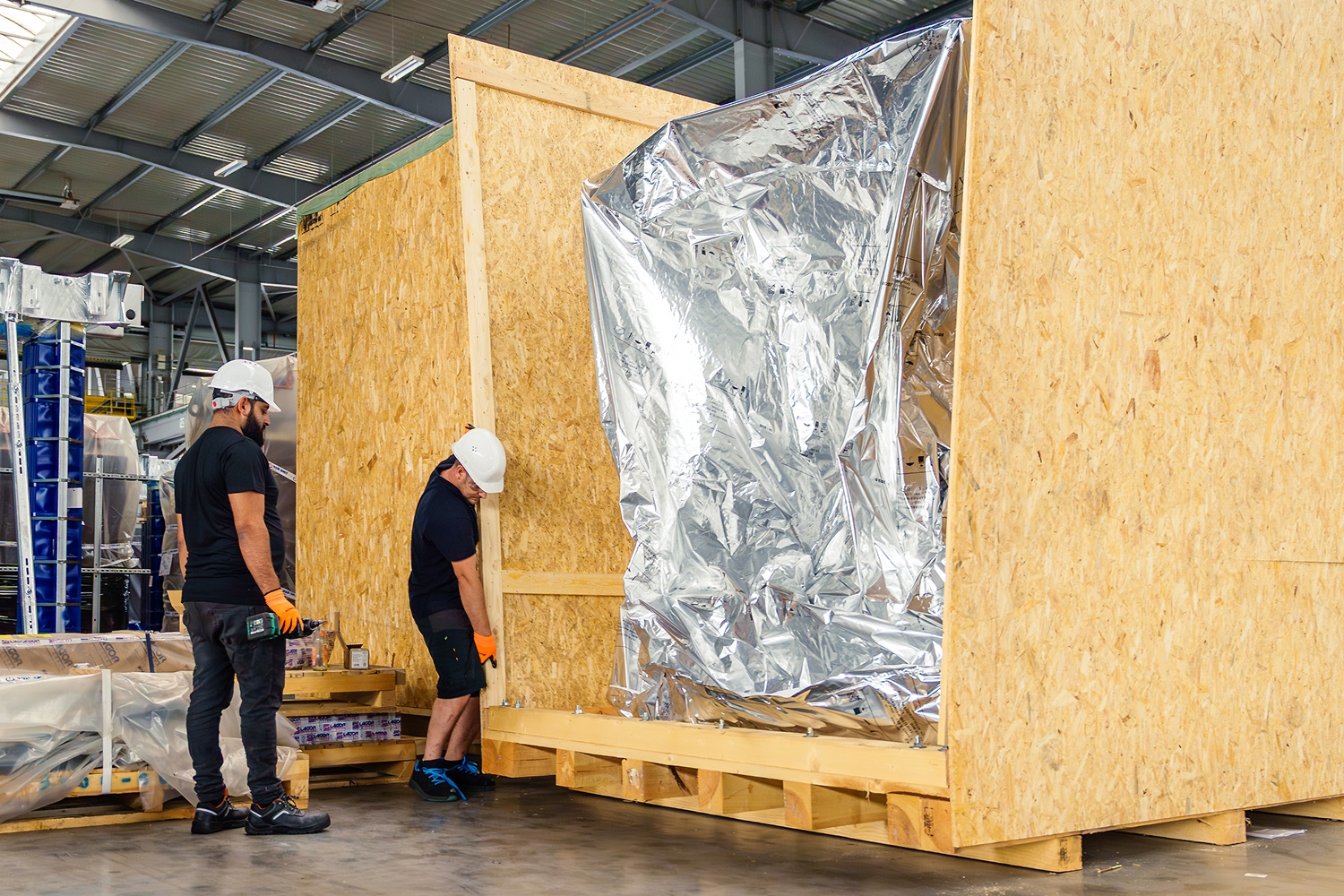

Conservation, moisture protection and load securing in Regensburg
In Regensburg, our teams work directly on the component: degreasing according to specifications, applying corrosion protection, drawing in VCI protection or aluminum composite with tightness testing, inserting drying agents according to the calculation formula (DIN/ HPE) and sealing the case.
It is then fixed to substructures or boxes, including security for crane and forklift handling, so that the component remains stable at every transfer point.
In export processes in Bavaria, sea freight packaging is fully documented: desiccant quantities, film numbers, envelope condition and closing points. As a result, the protection remains comprehensible throughout the entire transport route — right up to removal by the recipient.

Sea freight packaging
Aluminium composite film
Desiccant method
VCI conservation
Export packing
CTU code
Frequently asked questions
In Regensburg we use aluminum composite film because it Barrier properties has: it keeps moisture and ambient air out. In combination with a calculated amount of desiccant, a closed climate room, which prevents corrosion.
We calculate the amount of desiccant using the following formula: envelope volume, transportation time, climatic route and material vulnerability. This is how a verifiable protective effect, not an estimate.
In Regensburg, we work with a two-stage protection system: first, the component is preserved or passively protected, then it is welded into a tight barrier layer (aluminum composite) and the necessary amount of desiccant is inserted. As a result, the humidity remains stable, even during severe temperature changes in and on intercontinental sea routes.

93173 Wenzenbach