HPE standard industrial packaging
When machines, systems, or components are transported, the packaging determines whether they arrive safely — or damaged. Industrial packaging is therefore not a logistical side process, but a central component of the industrial value stream. It not only protects goods, but also secures supply chains, production continuity, and operational processes.
Requirements are particularly high when it comes to international shipping or long-term storage. Here, the HPE standard forms the basis for executing packaging in a predictable, standards-compliant, and resilient manner.
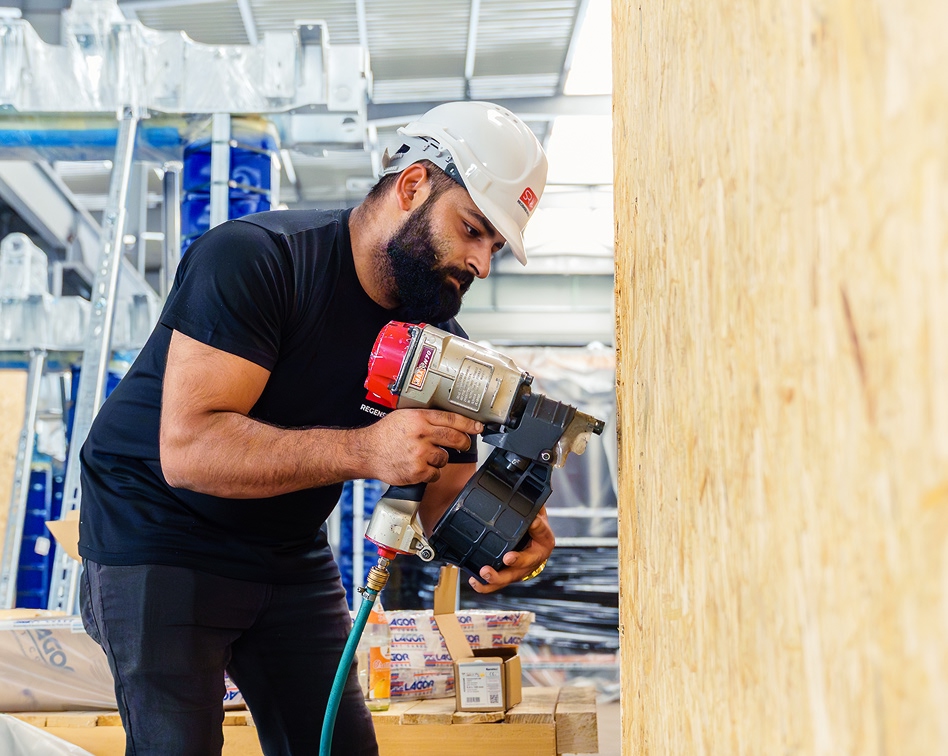
In Regensburg and throughout Bavaria, we package machines, spare parts, plant components, and complete systems for industrial companies, machine builders, and plant manufacturers. Packaging is carried out either in our own halls or directly at the customer’s site. It is not only the material that is decisive, but also the calculation, design, and documentation.
Design is based on load — not on feeling
The wood, format, and construction of a crate are not derived from estimation, but from weight, center of gravity, lifting points, transport route, and storage conditions. A box for a component weighing 800 kilograms has different requirements than one for a 12-ton transformer.
If dimensions are incorrect, risks arise: deformation, vibration fractures, punctures, or shifts in the center of gravity during lifting.
The HPE standard therefore defines construction types and wood thicknesses by load class. These rules are not bureaucracy, but a matter of safety — for the goods, transport personnel, and operations. Industrial packaging is professional when the construction is comprehensibly justified.
Protection against moisture and corrosion
During export or long-term storage, mechanical damage is often not the greatest risk — moisture is. For this reason, components are frequently wrapped in welded aluminum composite film and filled with desiccants. The film protects against external water vapor, while the desiccant stabilizes the internal climate.
In this way, the preservation period can be clearly defined — often for 6, 12, or 24 months. This is not an addition, but an essential part of the packaging.
Fixation and security during transport
“Packing” does not end with the box. The decisive factor is how the component is positioned and secured inside.
Wooden supports, screws, underlays, and tie-down points must be designed to absorb acceleration forces during transport. This is where the CTU Packing Guidelines apply, setting international standards for transport stability.
In Regensburg and across Bavaria, we regularly package machines and technical goods directly at the customer’s site. This enables short distances, fast coordination, and consistent quality — regardless of whether the goods are later transported by truck, container, or air freight.
Industrial packaging is responsibility in detail
Most damage is not caused by major errors, but by minor inaccuracies: a missing document, an incorrectly placed screw point, or insufficiently welded film. Professional industrial packaging identifies these details before they have an impact.
It is not a question of speed, but of attentiveness and experience.
Source context & references
Key message
- HPE packaging guidelines
Industrial packaging must be designed according to load and transport conditions. - CTU Code (IMO / ILO / UNECE)
Securing cargo during transport is a safety-relevant standard, not an optional procedure. - VDI 2700 — Load securing
Fixation and force flow are decisive, not merely the external strength of the crate.
Intersection:
Safety comes from planning, calculation, and documentation — not from “experience alone.”
Contradiction in practice:
Many packages appear stable from the outside but are structurally incorrect — risks only become apparent during transport.
Conclusion
Industrial packaging means responsibility.
For the product.
For transportation.
For companies that depend on the component arriving undamaged.